
New Hair Transplant Technology 2024: Advanced Solutions at FUEsion Hair Clinics
Updated: Feb 4
Hair restoration technology has entered a defining era. What was once considered cutting-edge in 2024 has rapidly evolved, paving the way for even more intelligent, precise, and patient-centric solutions by 2026. Today, hair transplants are no longer just surgical procedures — they are technology-driven regenerative experiences.
At the forefront of this transformation is FUEsion Hair Clinics, a brand that not only adopted the most advanced and new hair transplant technologies of 2024 early on, but has also positioned itself ahead of the curve by integrating and preparing for the next generation of hair restoration technology in 2026.
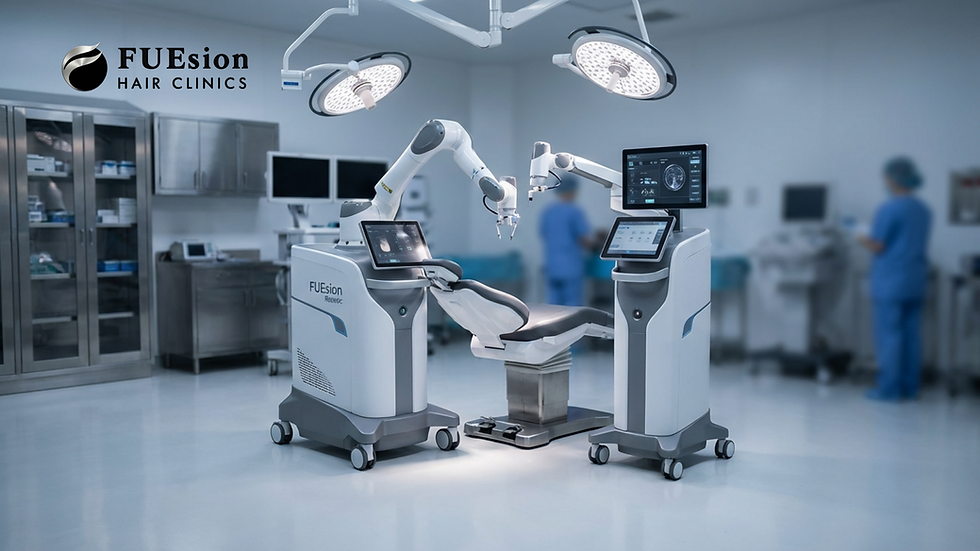
New Hair Transplant Technology in 2024: The Turning Point
The year 2024 marked a major shift in the hair restoration industry. Clinics moved beyond purely manual techniques and began embracing intelligent systems designed to support surgeons and improve outcomes.
Core Hair Transplant Technologies Introduced in 2024
In 2024, Clinics like FUEsion adopted the advanced technology FUEsion X System:
1. AI-Assisted Follicle Analysis
Artificial intelligence began playing a key role in:
Identifying healthy donor follicles
Mapping hair density and growth patterns
Reducing graft transection
Improving follicle survival rates
AI allowed surgeons to make data-driven decisions rather than relying solely on visual estimation.
2. Robotic Arm Assistance
Robotic support systems were introduced to:
Enhance hand stability
Maintain consistent extraction depth
Improve implantation accuracy
Reduce surgeon fatigue during long procedures
Importantly, in 2024, robotics were assistive, not autonomous — keeping surgeons fully in control.
3. Augmented Reality (AR) Visualization
AR tools allowed surgeons to:
Visualize hairline symmetry
Monitor graft angles and direction
Improve density distribution
Maintain consistency across the scalp
This significantly improved the natural appearance of results.
4. Advanced Graft Preservation
Cold storage and optimized hydration techniques introduced in 2024 helped:
Extend graft viability
Reduce follicle shock
Improve overall growth outcomes
5. Automated Implantation Tools
Atraumatic implanters improved:
Speed of implantation
Reduced scalp trauma
Precision of graft placement
Limitations of 2024 Technology
While revolutionary, 2024 technology still had limitations:
AI was supportive, not predictive
Robotics lacked adaptive learning
Hairline design still relied heavily on surgeon experience
Long-term growth forecasting was limited
These limitations set the stage for the next major leap: 2026.
Advanced Hair Transplant Technology in 2026: The Intelligent Era
By 2026, hair transplant technology evolves from assistance to intelligent collaboration, where systems actively learn, predict, and personalize outcomes.
FUEsion Hair Clinics is already aligned with this next-generation approach.
1. Predictive AI Hair Restoration Systems (2026)
In 2026, AI moves beyond analysis into prediction.
What Changes in 2026
AI predicts future hair loss patterns
Simulates long-term density outcomes
Designs hairlines that age naturally over decades
Optimizes donor area usage for lifetime planning
Instead of restoring hair for today, procedures are designed for how the patient will look 10–20 years later.
2. Adaptive Robotic Intelligence
Robotics in 2026 are no longer static tools.
Advanced Capabilities
Real-time adaptation to scalp resistance
Automatic micro-adjustments during extraction
Learning from surgeon techniques
Improved consistency across all grafts
Robotic systems evolve with every procedure, improving accuracy and safety continuously.
3. Full-Spectrum Augmented Reality & 3D Mapping
2026 introduces immersive AR combined with 3D scalp modeling.
Key Advancements
360-degree scalp visualization
Live density heat maps
Dynamic follicle direction overlays
Real-time feedback during implantation
This ensures unparalleled naturalness and symmetry.
4. AI-Driven Hairline Design Algorithms
Hairline creation becomes a blend of:
Facial recognition analysis
Ethnicity-specific growth patterns
Age-adaptive design models
Personalized aesthetic preferences
Surgeons retain artistic control, while AI ensures balance, proportion, and long-term realism.
5. Regenerative Integration with Hair Transplants
In 2026, hair transplantation integrates regenerative science.
Advanced Regenerative Enhancements
Exosome-based follicle stimulation
Growth factor delivery without needles
Cellular activation therapies
Improved follicle anchoring and healing
This results in:
Faster recovery
Stronger hair shafts
Improved long-term thickness
6. Ultra-Precision Graft Preservation Systems
Next-generation preservation systems maintain:
Optimal temperature
Oxygenation control
Nutrient-rich environments
Reduced ischemic stress
This significantly increases graft survival and growth consistency.
7. Non-Surgical AI-Powered Hair Restoration (2026)
Non-surgical treatments evolve dramatically.
Advanced Non-Surgical Technology
Ultrasonic trans-epidermal delivery
Pneumatic micro-delivery systems
Needle-free regenerative therapy
AI-controlled dosage precision
These technologies are ideal for:
Early hair loss
Maintenance after transplant
Density enhancement
Female hair thinning
How FUEsion Hair Clinics Bridges 2024 and 2026 Technology
FUEsion Hair Clinics is not waiting for the future — it is building it now.
Why FUEsion Is Already 2026-Ready
AI-powered follicle analysis
Robotic-assisted precision
AR-guided implantation
Surgeon-centric intelligent systems
Regenerative therapy integration
Predictive planning mindset
FUEsion’s philosophy ensures that patients receive results that remain natural not just today — but for years to come.
Technology Meets Human Expertise at FUEsion
Despite technological advancement, FUEsion maintains a core belief:
Technology enhances surgeons — it never replaces them.
Surgeons at FUEsion:
Design personalized hairlines
Control every extraction and implantation
Make artistic decisions AI cannot replicate
Adapt procedures in real time
This balance ensures precision without losing the human touch.
Impact on Results: 2026-Level Outcomes
Higher graft survival rates
More natural hairlines
Improved density consistency
Faster healing
Reduced trauma
Long-term aesthetic stability
Results are designed to age naturally with the patient, not just fill bald areas.
Affordability in Advanced Technology
Despite technological evolution, FUEsion maintains accessibility through:
Efficient workflows
Lower consumable costs
Transparent pricing
Flexible financing options
Free consultations
Advanced technology does not mean unaffordable care.
Free Consultation with Future-Focused Planning
FUEsion’s consultations include:
AI-assisted scalp analysis
Future hair loss prediction
Personalized technology-driven treatment plans
Clear expectations and timelines
Transparent cost breakdowns
FUEsion Hair Clinics Locations
FUEsion operates multiple advanced centers including:
Beverly Hills, CA
Brooklyn, NY
Buffalo, NY
Chicago, IL
Coral Springs, FL
Houston, TX
Las Vegas, NV
Miami, FL
Phoenix, AZ
Queens, NY
Santa Ana, CA(and more, with additional locations coming soon)
Conclusion: The Future of Hair Transplant Technology Is Here
Hair transplant technology has evolved rapidly from 2024 innovations to 2026-level intelligent systems. The future is defined by precision, prediction, regeneration, and personalization.
FUEsion Hair Clinics stands at the intersection of both eras — offering patients the benefits of today’s proven technology while preparing them for tomorrow’s advancements.
For those seeking not just hair restoration, but future-ready confidence, FUEsion represents the next chapter in hair transplant evolution.
Medical Information Notice/ Medical Information Disclaimer
This content is provided for general educational purposes only and reflects the clinical experience and protocols followed at FUEsion Hair Clinics. It is not a substitute for professional medical advice, diagnosis, or treatment. Patients are advised to consult a qualified hair restoration specialist for personalized recommendations.


Comments